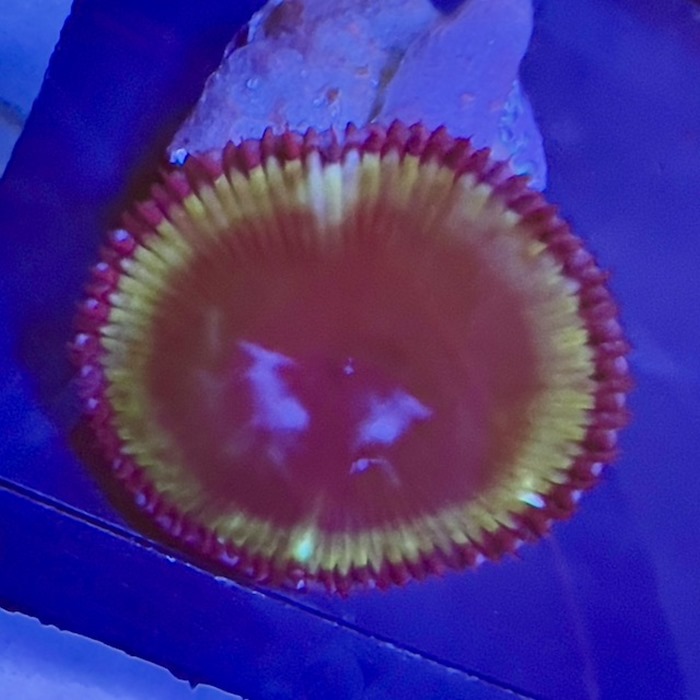
Palythoa Grandis
 Reward Points
You will earn 25 Points
 Free Delivery
On dry goods over £100
Free Delivery
On dry goods over £100
 Price Match Promise
We will beat any competitor
Price Match Promise
We will beat any competitor
 Speak to an expert
01446 737210
Speak to an expert
01446 737210
 Visit our showroom
Feel free to visit us!
Visit our showroom
Feel free to visit us!
The Palythoa Grandis is a bold colour variety of Protopalythoa polyp coral also known as Sea Mats, Button Polyps, Moon Polyps, or Encrusting Anemones. While most species of Protopalythoa corals are typically brown or tan in colour, the Palythoa Grandis sports a rich, oxblood red colouration with accents of mossy olive-green colouration that adorns its tentacles and the margins of its oral discs. As colonial animals, the Palythoa Grandis is made up of multiple individual polyps attached to a piece of live rock.
Protopalythoa polyp corals are relatively easy to distinguish from their Zoanthid cousins, boasting the largest polyps among all the Zoanthids. Protopalythoa polyp corals are found in a wide range of areas, commonly occurring on sandy reef flats and rocky, hard bottom habitats in shallow or deep water. Protopalythoa polyp corals are often described as having a similar appearance to the carnivorous Venus Fly Trap Plant featuring long, tapered tentacles used to ensnare any potential food items.
Similar to other Colony Polyp Corals, the Palythoa Grandis is relatively easy to maintain, making it a good choice for beginner reef aquarists. The Palythoa Grandis requires moderate to high light levels combined with medium water movement within the aquarium. The Palythoa Grandis grows rapidly and can potentially crowd out neighbours including any sessile life. In addition, the Palythoa Grandis has the ability to sting other animals and are semi-aggressive so be sure to provide ample space between the Palythoa Grandis and any neighbouring coral.
Under ideal conditions, the Palythoa Grandis will multiple without difficulty in home reef aquariums by budding (splitting off a portion of their base) to increase the size of the colony. The Palythoa Grandis contains symbiotic photosynthetic zooxanthellae algae that satisfy almost all the nutritional requirements of the Palythoa Grandis. However, if lighting conditions are not optimal, the Palythoa Grandis will benefit from weekly feedings of micro-plankton or brine shrimp fed to each individual of the colony. For continued good health, thePalythoa Grandis will require the addition of iodine and other trace elements to the water.
NOTE: Zoas contain palytoxin so take care when handling these corals